Archives des invisibles
Curators
Joana Hadjithomas et Khalil Joreige
KADIST
21 Rue des Trois Frères, 75018 Paris
October 10, 2026 - January 9, 2027
Artists
Namir Abdel Messeeh, Mohamad Abdouni, Kamal Aljafari, Ahmed Amer, Danielle Arbid, Cyril Aris, Kader Attia, Nader S. Ayache, Ismaïl Bahri, Mehdi Barsaoui, Éric Baudelaire, Kaouther Ben Hania, Afef Ben Mahmoud et Khalil Benkirane, Simone Bitton, Dominique Cabrera, Lana Daher, Alice Diop, Sofia Djama, Nabil Djedouani, Rana Eid, Souad El-Bouhati, Jihan El-Tahri, Mahdi Fleifel, Ahmad Ghossein, Alain Gomis, Tala Hadid, Annemarie Jacir, Bouchra Khalili, Yanis Koussim, Nadine Labaki, Sébastien Lifshitz, Laïla Marrakchi, Rayane Mcirdi, Najwa Najjar, Eliane Raheb, Amal Ramsis, Ghassan Salhab, Jayce Salloum, Elias Sanbar, Céline Sciamma, Zineb Sedira, Lina Soualem, Mohamed Soueid, Rania Stephan, Elia Suleiman, Virgil Vernier, Hady Zaccak, Rebecca Zlotowski.
Link to the exhibition
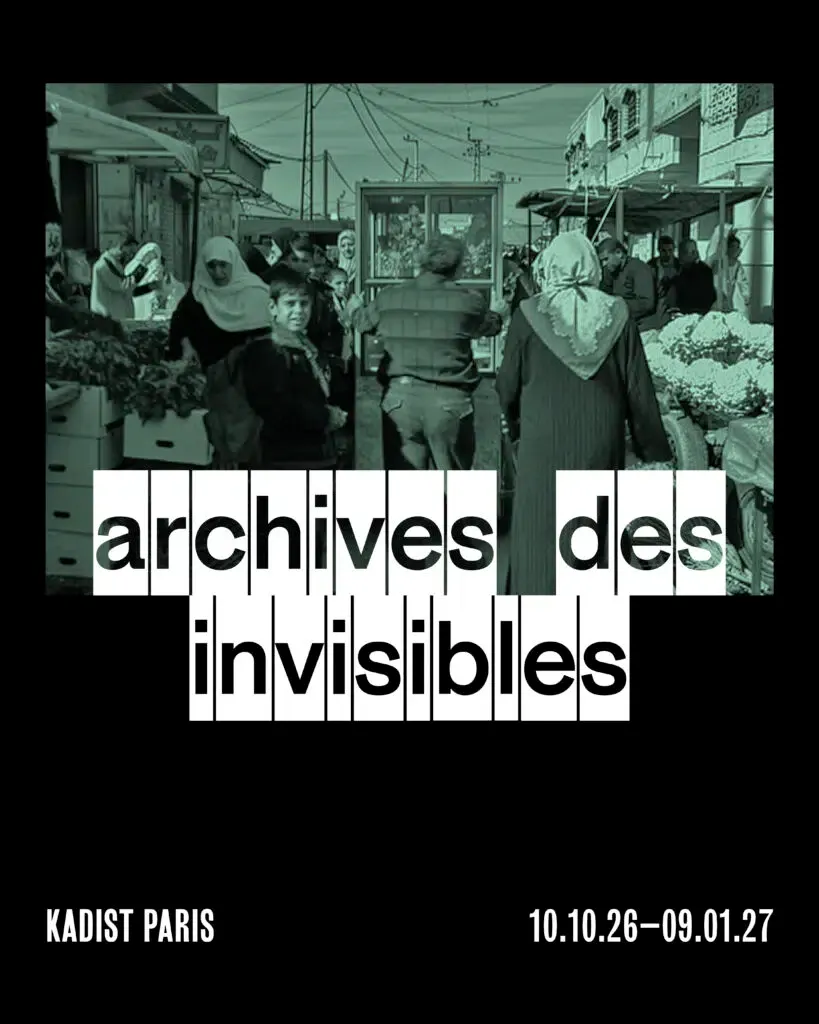
KADIST presents Archives des invisibles, a project by Joana Hadjithomas and Khalil Joreige. Bringing together filmmakers and artists mainly from the Mediterranean region (Morocco, Algeria, Tunisia, Egypt, Lebanon, Palestine) and France, this first chapter, takes the form of an exhibition presented at KADIST Paris from October 10, 2026 to January 9, 2027, accompanied by a program of talks, screenings, and tours.
Archives des invisibles arose from a simple question: what happens to the rushes, shots, and sequences that never found their place in an artwork? These images, faces, and landscapes, filmed, loved, then cast aside, often remain locked away on hard drives or in boxes, even as they continue to inhabit those who shot them. What would happen if, instead of remaining invisible, they were shared?
Each artist and filmmaker is invited to reveal one or more previously unseen sequences from their own practice, whether recent or older. Each excerpt is accompanied by testimony gathered by Joana Hadjithomas and Khalil Joreige, restoring its context, history, and memory. Why does this sequence continue to inhabit its author? Why was it set aside during editing? Was it for aesthetic or political reasons, due to censorship, or simply because it did not find its place in the film? Who do these images belong to today? What faith do we place in our images? Together, these accounts compose a living archive, in perpetual construction.
Archives des invisibles raises several key questions about the creative process: what we choose to show or leave out of frame; the images we give up; what it means today to transmit, archive, and index; and the way forgotten narratives can be reactivated, particularly those tied to migration, plural identities, and stories both intimate and collective.
The exhibition places these previously invisible rushes alongside one another, revealing correspondences, resonances, or dissonances between the works. It traces a sensitive cartography of the territories, histories, and aesthetics that run through the project.
Archives des invisibles is a collective journey that seeks to offer these long overshadowed images the possibility of new circulation and new readings. It will continue beyond the exhibition through other forms: screenings, publications, talks, and further exhibitions.