In Interludes and Transitions
Third edition of the Diriyah Contemporary Art Biennale
January 30–May 2, 2026
Artist list
Pacita Abad, Pio Abad, Rand Abdul Jabbar, Abdullah Miniawy Trio, Etel Adnan, Yussef Agbo-Ola [Olaniyi Studio], Leen Ajlan, Ahaad Alamoudi, Elyas Alavi, Afra Al Dhaheri, Shadia Alem, Mohammad Al-Ghamdi, Mohammed Alhamdan (7amdan), Nouf Al-Harthi, Ramy Alqthami, Abdullah Al Saadi, Ruba Al-Sweel, Lulua Alyahya, Ismaïl Bahri, Taysir Batniji, Dineo Seshee Bopape (Raisibe), Raven Chacon, Ayman Yousry Daydban, Nolan Oswald Dennis, Rohini Devasher, Merve Ertufan, Ivana Franke, Rahima Gambo, Eric Gyamfi, Samia Halaby, Petrit Halilaj, Hazem Harb, Aziz Hazara, Ho Rui An, Alana Hunt, Kamala Ibrahim Ishag, Amaka Jaji, Kayfa ta, Yazan Khalili, Moshekwa Langa, Daniel Lind-Ramos, George Mahashe, Guadalupe Maravilla, Naminapu Maymuru-White, Théo Mercier, Nour Mobarak, Mochu, Nancy Mounir, Hussein Nassereddine, Daniel Otero Torres, Thảo Nguyên Phan, Gala Porras-Kim, Sarker Protick, Abdelkarim Qassem, Raqs Media Collective, K.P. Reji, Faisal Samra, Oscar Santillán, Amina Saoudi Aït Khay, Bogosi Sekhukhuni, Karan Shrestha, Elias Sime, Trương Công Tùng, Rajesh Chaitya Vangad, Wolff Architects, Agustina Woodgate, Müge Yılmaz, and Yu Ji.
Diriyah Contemporary Art Biennale
JAX District
Diriyah
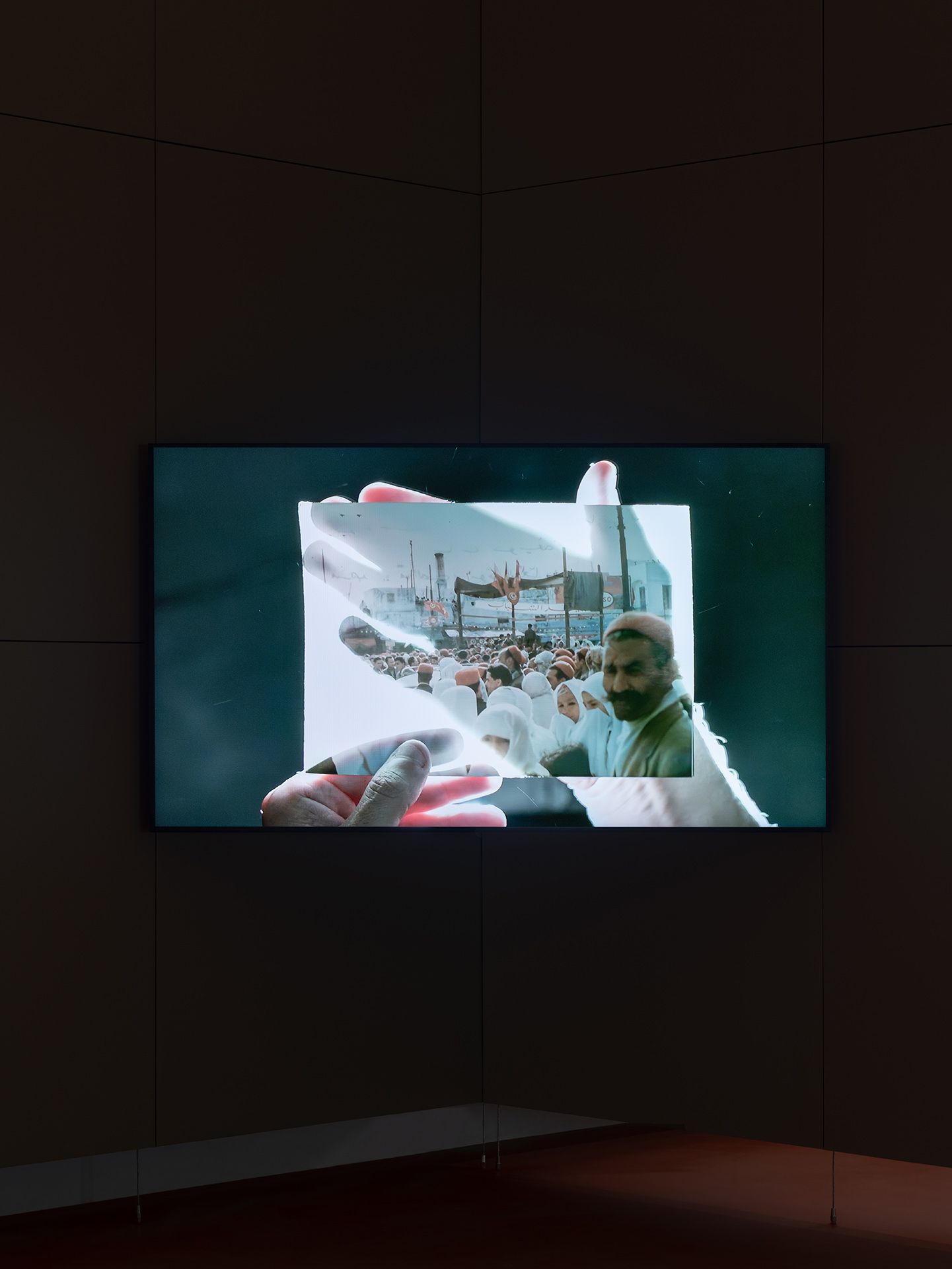
The third edition of the Diriyah Contemporary Art Biennale [organized by the Diriyah Biennale Foundation in the JAX District, Riyadh, Saudi Arabia, January 30 to May 2, 2026] considers the world as a multitude of processions, taking as its point of departure the movements, migrations, and transformations that have long connected the Arab region with the world.
The nomadic and Bedouin communities from the region defined their relationship with the world through the aeolian, wind-driven rhythms of the desert, migratory kinships, and through shared language and oral traditions. Knowledge of the movement of stars and winds, the location of water sources, and animal behavior were their technologies of navigation, survival, and sustenance.
Processions have also been an integral component of life in the region for centuries; trade, pilgrimage, migration have been carriers and producers of cultural forms. These processions were bearers of stories, songs, rhythms, and languages. The rajaz, one of the earliest poetic meters in the Arabic verse, is synched to the camel’s rhythmic step across long journeys.
The titles of the Biennale evoke a world in transition. The Biennale’s title in Arabic, fil hil wal terhal, draws from a phrase often used colloquially to evoke connection and continuity within a state of constant flux. It recalls the pause and movement that characterizes nomadic life, while invoking the solidarity and communal ties that stay connected throughout. The English title, In Interludes and Transitions, carries these meanings, but also connects to registers of music, composition, and theater. It is an invitation to think rhythmically, to approach time as layered, pulsating, and collectively embodied. Rather than considering pause and motion in opposition, the Biennale approaches them as generative of cycles of itinerancy.
To live in interludes and transitions is to rethink the world in intense motion, as a choreography that entangles humans with planetary, multispecies, spiritual, and technological currents. It is to think of relations not as a static constellation, but as an ensemble of moving vectors. Thinking of our times through these movements is to partake in moments of commemoration and in movements of solidarity. It proposes to retell fragments of exiled stories that have persisted through bodies, materials, and rhythms. In these movements, the world is always in translation, and everything in it always in a state of becoming something else.
To regard the world in procession is to perceive history as a continuum of multiple timelines (human, planetary, and mythic) rather than a fixed chronology. Histories in procession gesture toward an embodied practice, where the past does not recede but strides alongside the present. They celebrate the collective over the individual, ritual over the record, process over outcome, the granular over the monumental. As a choreography that is both prefigured and yet improvised, processions inscribe meaning onto the landscape. Imbuing the route itself with memory, a procession is how societies make meaning in motion. Every procession has the capacity to blur hierarchies, alter inherited forms, and express new solidarities. Every procession is an affective claim to presence.
Histories in Procession
In the wake of the first quarter of the twenty-first century, it is impossible to ignore the tectonic shifts defining our present moment. How long and wide one can trace lines of causality for these shifts is debatable. It is abundantly clear, however, that events seemingly buried in the past have erupted into the present, evidenced through ecological crises, mass migrations, social and economic disparities, and dispossession. It is in this climate that the Biennale seeks to find its voice as a space for the reflection and articulation of new imaginations of belonging. Forms of belonging that are not tied to a single origin but to itineraries that keep expanding; not tied to one mother tongue but to many other tongues; not tied to one community but to numerous affinities.
Owing to its geographic location and position as a vital node in the vast networks of knowledge, resource distribution, and religious pilgrimage, this region has always been keenly attuned to the tremors of global shifts. In curating this Biennale, we were interested in thinking of how the world appears from this region rather than how this region appears to the rest of the world; a thinking from not a thinking about. This perspective has kept unfolding through the metaphor of processions, the movement of communities from near and far, the flows of commodities and global capital, and the migration of birds and insects.
Stories are the quintessence of nomadic movement. Rather than mere repositories of knowledge, they are perpetually in transition, producing new subjects and communities. They shape perceptions and capacities for relation. Every retelling and adaptation produces new territories of meaning. Histories, similarly, are plural and never singular. Rather than being fixed narratives, they instantiate nomadic distributions of power, negotiated between material evidence, lived realities, and the stories that weave the two. Recognizing histories as processions, then, is not a simple act of movement, but a complex process of collective transformation.
The Biennale understands the procession as a form of pedagogy and a way of learning in rhythms, in chorus with the multiplicity of voices, senses, geographies, and histories. It reminds us that to remember is to move; to become dislodged from fixed positions in order to drift toward new configurations. In this sense, the Biennale is a passage through which several processions shaping the world today pass, in a choreography of relations and as an open score through which histories and futures can be rehearsed together.
Sonic as Method
The concept of aurality deeply informs the curatorial approach to the 2026 edition of the Diriyah Contemporary Art Biennale. From folktales to poetry and familial narratives to songs, oral and aural modes of knowledge transfer have been a fundamental part of ensuring the continuation of social histories in the Arab region and beyond. In the Biennale, this is articulated through the foregrounding of musicality and the exploration of sonically connected geographies, as histories create resonant fields from Cairo to Khartoum and Beirut to Batanes. How can a focus on the sonic and on the act of listening produce a new understanding of communal relations—not only between humans but domains that are more than human? How does our understanding of our past, with the necessary fabulations that this entails, bear on our current realities?
The sonic, in this sense, is not limited to being a medium but is also a method. In Interludes and Transitions is interested in the sonic as a way of exploring the tools and concepts used to orient oneself in the world. To cite the oft quoted feminist theorist and educator Donna J. Haraway, “It matters what stories we tell to tell other stories with; it matters what knots knot knots, what thoughts think thoughts … It matters what stories make worlds, what worlds make stories.”1 What stories might need to be told to imagine and enact a world otherwise?
As poet and philosopher Édouard Glissant wrote, “What we call the world today is not only the convergence of the histories of peoples that has swept away the claims of philosophies of History but also the encounters (in consciousness) among these histories and materialities of the planet.”2 In his writings, “the world” is a name for the relation between all things, and it appears threefold: as “tout-monde” (the world in its totality), as “écho-monde” (the world of resonances), and “chaos-monde” (a world that resists systematization).3 We draw inspiration from the “écho-monde,” the world as resonance, as vibration, as echo and polyphony. To think through resonance and echoes is to think with simultaneity and overlap, and to acknowledge that meaning and expression are not confined by territorial boundaries, but meet in complex and unexpected ways. In their polyphonous transmission lies their resilience, much like the winds that carry songs and harvest, but also the fury of storms and plagues.
As a curatorial method, the sonic invites visitors to experience the Biennale by way of listening to difference without seeking to harmonize it. Through a sonic relationship between artworks, one is carried into a field of reverberations: echoes, amplifications, chants, songs, the fluidity of oral cultures, the multitude of languages, dialects, accents, and impure tongues. Glissant reminds us that we must learn to tremble with the world, to let the vibrations of others move through us. To curate sonically, therefore, is to curate relationally, to allow for overlapping tempos, syncopation, and interruptions. The Biennale conjures the past into the present through material sediments, oral traditions, memories, and hauntings. It is envisioned as a site where agonistic narratives meet. It is not a space of resolution but of resonance.
We hope this edition of the Biennale asks critical questions about how we may rethink society and belonging in the twenty-first century, through other lexicons, images, enactments, and rhythms. The African American writer and civil rights activist James Baldwin famously said, “The world is held together, really it is, held together, by the love and the passion of a very few people.”4 The Biennale celebrates this impulse with each artwork, each expression, and gesture that carries within it that power.
We hope that each visitor who attends this edition of the Biennale feels an awakening of attention to processions that are not only shaping the world, but which they are a part of. An awareness that they are implicated in the historical convulsions of our time; in step with the inhales and exhales of trillions of life-forms; in solidarity with millions of those who cannot breathe; and in sync with millions of others whose hearts skip a beat when they experience something profound.
In the words of the poet and artist Etel Adnan, “Memory, and time, both immaterial, are rivers with no banks, and constantly merging. Both escape our will, though we depend on them. Measured, but measured by whom or by what? The one is inside, the other, outside, or so it seems, but is that true?”5
In the end, In Interludes and Transitions is an invitation to listen to the world as it moves, vibrates, and trembles through us; to hear in its multiplicity not chaos but a chorus. We hope that what remains during and after the Biennale is not only a memory of artworks or exhibitions, but an attunement and capacity to move and be moved, to listen and be heard, and to tremble with the world.
[. . . ]
Read the entire essay in In Interludes and Transitions.